


 English
 Français

If your search for "fabric loops" surfaced sewing tutorials about rouleau button loops, you may be looking for a different answer than the one a product developer needs. In the fastener industry, fabric loops are the soft, looped component of hook-and-loop closures—the half that creates the fuzzy surface and the mechanical anchor for the hooks. The loop side controls how firmly the closure engages, how it feels, and how long it lasts. This guide explains fabric loop materials, constructions, selection criteria, and sourcing quality checks from a hook-and-loop manufacturer's viewpoint.
Why Fabric Loops Matter as Much as the Hook Side
The loop side determines the functional performance of a hook-and-loop fastening. Hooks only work when they have a compatible loop pile to grab. A fabric loop with low loop density, poor pile recovery, or weak loop yarn can cause the closure to peel, creep, slip, or lose engagement long before the hooks fail. For the full system view, start with our comprehensive guide to textile fasteners.
When specifying fabric loops, focus on these properties:
- Loop density – higher loop counts generally improve shear strength and peel resistance.
- Pile height – short piles feel softer and generate less noise, but the hook length must match the pile.
- Loop pull resistance – the force required to pull one loop out of the base weave; a high value prevents pilling and snagging.
- Base fabric construction – a stable, flat weave makes the loop tape easier to cut, sew, weld, or laminate.
- Finish and dye compatibility – added coatings or dyes must not block the loop opening or reduce loop flexibility.
Fabric Loop Materials: Nylon, Polyester, and Blends
Nylon and polyester are the two dominant fiber families for continuous textile fabric loops. Nylon offers high loop strength, elasticity, and dyeability at a practical cost. Polyester offers lower moisture absorption, better UV resistance, and excellent dimensional stability, especially in outdoor or humid environments. Blended constructions combine the two fibers to balance mechanical properties and resistance.
For general-purpose fastening, an all-nylon fabric loop is the standard choice. It delivers high loop tenacity, recovers well after repeated open-close cycles, and accepts a wide range of colors.
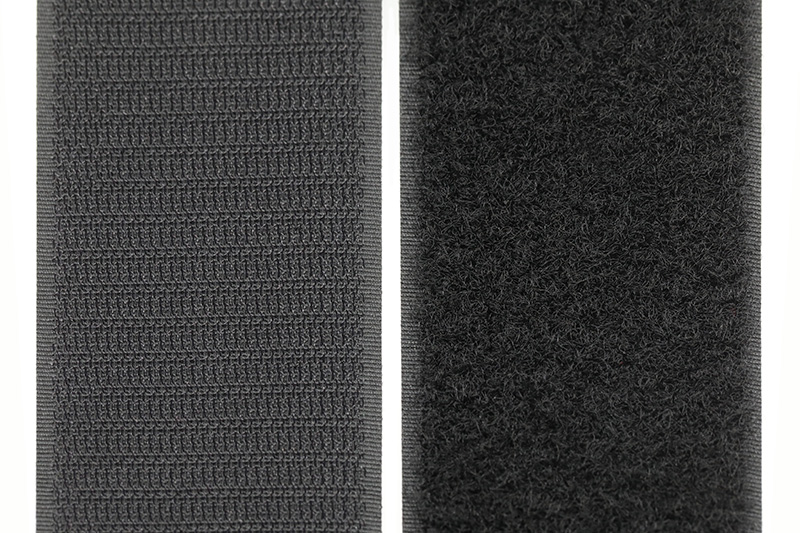
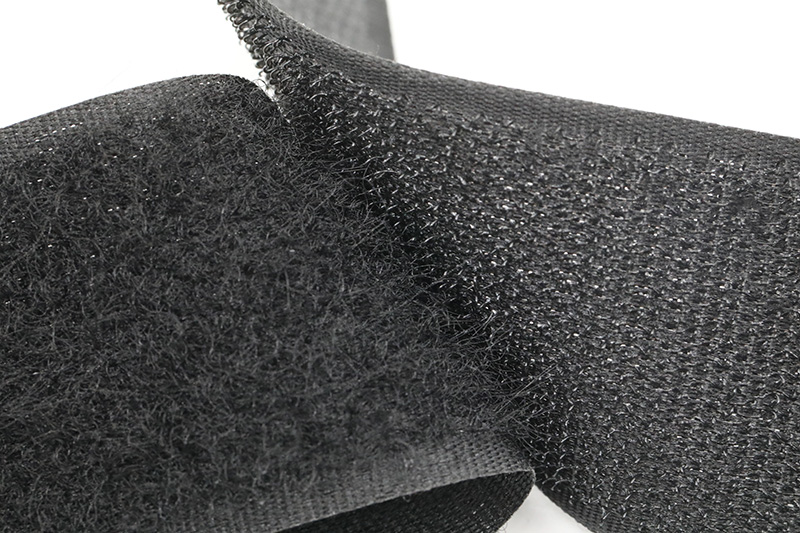
When outdoor exposure is a risk, specify an all-polyester fabric loop. Polyester loops hold up better under sunlight, moisture, and repeated washing, making them common in marine, automotive, and sports applications.
| Material | Main advantage | Typical applications | Sourcing consideration |
|---|---|---|---|
| Nylon loop | High loop strength, elasticity, good dye affinity | Apparel, footwear, bags, industrial straps | Can absorb moisture; needs correct washing/cleaning |
| Polyester loop | Low moisture pickup, UV resistance, color stability | Outdoor, marine, automotive interiors | Usually higher cost; different dyeing process |
| Blended loop | Balanced strength and environmental resistance | Furniture, consumer goods, pet products | Properties depend on blend ratio and finish |
Specialty Fabric Loops for Specific Failure Modes
Standard loop tape is often enough, but demanding applications call for specialty constructions. The right specialty loop prevents a problem that would otherwise appear after installation: fire codes, moisture delamination, tear propagation, or precise profile needs.
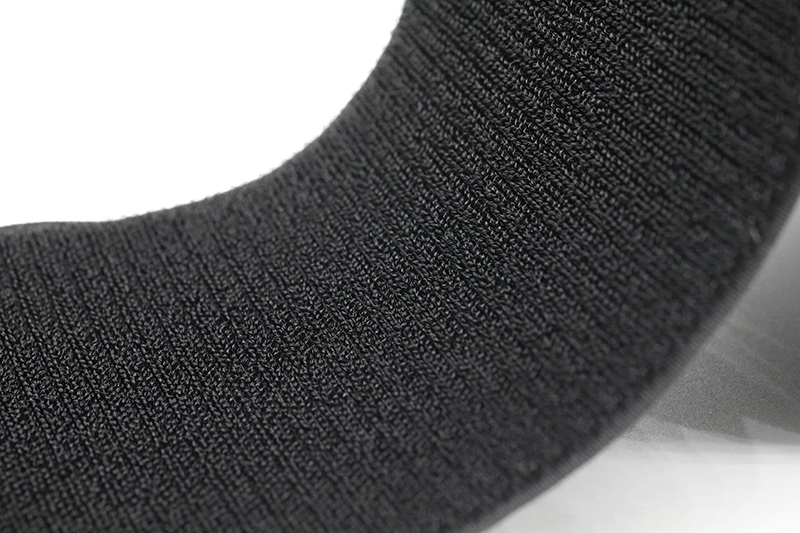
Unapped Nylon Loop
An unapped loop has not been brushed or napped to raise fibers. This produces a flatter, more compact loop surface that offers a lower profile and can be easier to laminate or weld. It is useful when the fastening must engage with molded hooks while keeping a thinner overall thickness.
Flame-Retardant Nylon Loop
Flame-retardant loops are made with treated or inherently modified fibers that reduce flame spread. They are used in seating, transportation, and protective equipment where fire safety standards are part of the sourcing specification.
High-Frequency Weldable Loop
A high-frequency weldable loop integrates a layer or yarn system that responds to radio-frequency welding. This lets manufacturers bond the loop tape to PVC, PU, or other synthetics without sewing, reducing water ingress and manufacturing steps.
Resists-Tearing Nylon Loop
Tear-resistant loops add a reinforcing scrim or engineering structure to stop ripping along the edge of the tape. They are useful in heavy-duty bags, harnesses, and tactical equipment that sees sharp forces.
How to Choose the Right Fabric Loop
The right fabric loop is selected by combining three factors: closure frequency, environmental exposure, and user comfort. No single loop works for every application; the correct choice is the one that fails least and lasts longest in the intended use.
- Define closure frequency – high-frequency applications like backpacks or protective vests need loops with good pile recovery and high loop pull resistance.
- Consider temperature and humidity – humid or wet climates favor polyester or specially finished nylon; high-temperature sections may require flame-retardant or heat-stabilized versions.
- Choose pile height to match the hook length – a hook that is too long for a low-pile loop will tear it; a hook too short for a high-pile loop will not engage fully.
- Assess user contact – medical, baby, or next-to-skin applications benefit from soft loops with low friction; hard or rigid loops can cause irritation.
- Build in test margins – ask for peel and shear data that exceed your application requirement by a known margin, not just the minimum standard.
Textile Fabric Loops Versus Injection-Molded Hook-and-Loop
Injection-molded hook-and-loop is not a fabric loop, but it is an alternative fastening system that can replace a textile loop in certain product designs. Molded structures provide precise, rigid hooks and loops in polypropylene or nylon, while textile fabric loops remain flexible and conformable. The decision affects closure strength, thickness, and manufacturing cost. For a closer look, see the injection-molded hook-and-loop category.
| Property | Textile fabric loop | Injection-molded hook-and-loop |
|---|---|---|
| Flexibility | Soft, conforms to fabric and curved surfaces | Stiffer, 3D structure that holds a shape |
| Thickness | Thin and stackable | Thicker, with more defined hooks and loops |
| Closure feel | Fuzzy, low noise | More tactile, often audible snap |
| Production cost | Lower custom tooling cost, high-volume textile process | Mold/tooling cost; unit cost depends on volume |
| Typical use | Apparel, bags, furniture, consumer goods | Electronics, cable management, automotive components |
Sourcing Quality Checks for Fabric Loops
Reliable sourcing is not just about receiving a roll of loop tape; it is about consistent loop geometry, stable base fabric, and testable mechanical strength. A supplier with in-house control over weaving, dyeing, and testing can deliver loops that behave the same from batch to batch. Before production, verify the following:
- Width tolerance – typical textile fastener tape runs within ±1 mm width; a wider variation disrupts automated cutting and sewing.
- Base weight and loop density – these values appear on the datasheet; re-check them for every incoming lot.
- Peel and shear strength – use standardized test methods and compare results to your closure load requirement.
- Dye lot consistency – mismatched dye lots create visible color lines on products with exposed loop tape.
- Finish and coating stability – some coatings reduce loop engagement; confirm that any finish does not plug the loops.
- Environmental resistance – ask for high/low temperature and humidity test data when the product will face extreme use.
Frequently Asked Questions About Fabric Loops
What is a fabric loop in hook-and-loop fasteners?
A fabric loop is the soft, napped or looped component of a hook-and-loop closure. It provides the fibrous structure that hooks catch and hold when the two sides are pressed together.
Is a fabric loop the same as hook-and-loop tape?
No. Hook-and-loop tape is the complete system with a hook side and a loop side. Fabric loop is the looped half, often supplied separately as loop tape for mating with hook tape.
Can I buy fabric loops separately?
Yes. Fastener manufacturers sell loop tape as a separate SKU. This is useful when a product needs hook tape on one part and loop tape on the other without bonding the two into one strip.
What does unapped loop mean?
An unapped loop has a flattened, less fuzzy surface because the loop yarns are not brushed or napped. It provides lower profile and precision for mating with certain molded hooks.
How do I choose between nylon and polyester fabric loops?
Choose nylon for strength, elasticity, and dye range in dry indoor applications. Choose polyester for UV exposure, moisture resistance, and outdoor or marine durability. Blends offer a middle ground.
Fabric loops are not a commodity detail. They define how a hook-and-loop closure feels, how much force it can take, and how many open-close cycles it survives. Start from the application, verify the loop material and construction, and demand test data from your supplier. That approach will keep your product reliable from prototype to production.



