


 English
 Français


Low surface energy materials are the plastics and coatings that adhesives quietly fail on: polypropylene, polyethylene, PTFE, polystyrene, acetal and most silicone-bearing surfaces. The working rule is that anything below roughly 36 dynes/cm needs a different plan. You either raise the surface energy with plasma, corona, flame, chemical etching or a primer, or you stop asking the joint to depend on wetting and switch to a mechanical fastening method such as hook and loop.
That decision usually arrives late, after a label has lifted in a warehouse or a taped bracket has dropped off a housing in transit. What follows covers what the numbers mean, why adhesion breaks down, which treatment or fastening route fits which substrate, and the specification points that separate a joint that lasts from one that only passes first inspection.
What qualifies as a low surface energy material?
A material is low surface energy when its surface tension falls below about 36 dynes/cm (36 mN/m), the practical cut-off most adhesive suppliers use before labelling a product "LSE".
Surface energy describes how strongly the top molecular layers of a solid attract a liquid. High energy surfaces such as clean metal, glass and ceramic pull a droplet flat, letting an adhesive spread into intimate contact. Low energy surfaces do the opposite: the droplet beads up, air stays trapped in surface valleys, and the adhesive touches only a fraction of the area it was formulated to grip. The standard wetting rule is that an adhesive wets a substrate only when its own surface tension sits well below the substrate's surface energy, usually by a margin of 10 dynes/cm or more.
| Material | Approximate surface energy (dynes/cm) | Classification |
|---|---|---|
| PTFE | 18 | Very low |
| Silicone elastomer | 20 to 24 | Very low |
| Polypropylene (PP) | 29 to 31 | Low |
| Polyethylene (PE, HDPE, LDPE) | 31 | Low |
| Polystyrene (PS) | 33 to 36 | Low |
| Acetal (POM) | 36 to 38 | Borderline |
| PET | 41 to 44 | Moderate |
| Polycarbonate | 42 to 46 | Moderate |
| Nylon 6/6 | 46 | Moderate |
| Aluminium (clean oxide) | About 840 | High |
| Glass | 250 to 500 | High |
Why adhesives struggle on low surface energy plastics
Adhesive failure on a low energy plastic is almost always a wetting and boundary-layer problem, not evidence that the adhesive was too weak.
Three mechanisms do most of the damage. First, poor wetting leaves micro-voids at the interface, so the load is carried by a small contact patch and peel strength collapses. Second, a weak boundary layer forms: mold release sprays, slip agents, antistatic packages and plasticiser bloom all migrate to the surface and sit between the polymer and the adhesive. Third, polyolefins have almost no polar groups, so acrylics and other adhesives that rely on acid-base interaction have little to bond to.
The symptoms are predictable once you know to look for them:
- Pressure-sensitive labels lift at the edges within weeks, especially in warm storage.
- Tape peel values land at half or less of the datasheet figure, which was usually generated on stainless steel.
- Printed ink rubs or flakes because the ink never anchored to the substrate.
- Sealed or potted assemblies leak at the interface after thermal cycling.
- Bonded trim rattles loose after a few hundred hours because the two materials expand at different rates.
The most expensive mistake is approving a joint on aluminium coupons and then running production on a PP housing. Qualification belongs on the real substrate, with the real mold release, at the real service temperature.
Two strategies that actually work
There are only two dependable strategies on low surface energy materials: change the surface, or change the fastening principle.
Surface treatment routes and what they buy
- Plasma (vacuum or atmospheric) lifts PP and PE from around 30 to 50 to 70 dynes/cm without changing appearance. The gain ages, so bonding usually needs to happen within hours or days of treatment.
- Corona discharge is the inline choice for film and extrusion. It is cheap per square metre and fades in storage, so film should be converted promptly.
- Flame treatment suits profiles and thick sections, but heat distortion and inconsistent burner setup cause variable results.
- Chemical etching with sodium naphthalenide is the proven route for PTFE. It works, but it is hazardous, adds handling steps and is difficult to control consistently.
- Primers and tie layers such as chlorinated polyolefin primers help on TPO and painted surfaces, at the cost of an extra process step and solvent management.
All of them share one weakness: the improvement is invisible. A treated part looks identical to an untreated one, so the process needs a dyne pen or contact-angle check at the line, not a visual inspection.
Adhesive selection is not a substitute for surface energy
Acrylic systems formulated for low energy surfaces give the most consistent results on polyolefins; ordinary rubber-based tapes wet them poorly no matter how thick the adhesive coat. Silicone adhesives wet low energy substrates well but deliver modest peel. Thicker adhesive can compensate for surface roughness, never for chemistry.
When mechanical fastening is the better answer
If the joint must be reopened, if the substrate cannot be pre-treated in the process, or if contamination control rules out primers, then adhesion is the wrong tool. A mechanical closure removes surface energy from the equation entirely.
Hook and loop on low surface energy parts
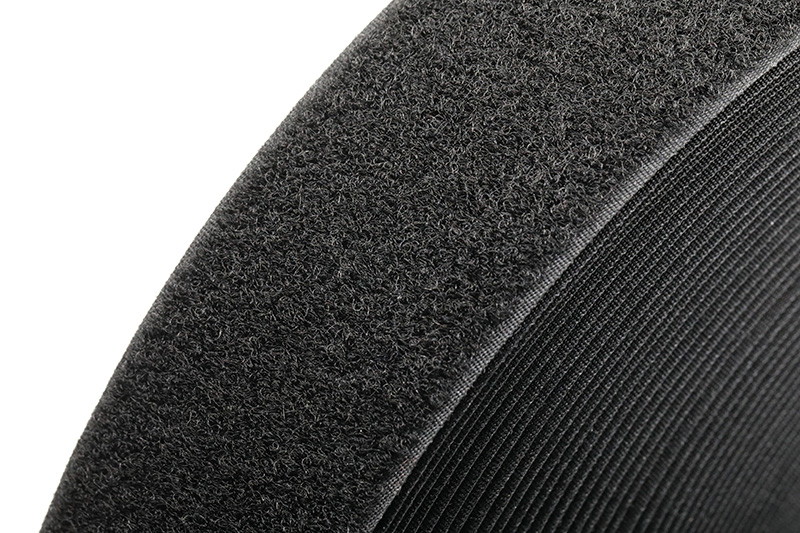
Hook and loop holds on low surface energy components because the load travels through interlocking geometry, not through chemical wetting: the hook engages the loop, peel and shear are resisted mechanically, and the surface chemistry of the panel underneath barely enters the calculation.
The attachment is where the engineering still happens. Sewing or stitching suits textile constructions. Rivets and screws suit rigid housings with wall thickness to spare. Ultrasonic welding suits PP and PE, which are both weldable and where the low surface energy that defeats adhesives is irrelevant. Adhesive-backed fasteners remain viable when an LSE-rated acrylic is combined with a properly cleaned and, if needed, treated surface.
Our PP and nylon injection molded hooks are moulded rather than woven, which keeps hook geometry consistent through repeated closures, and they can be specified with a plain, edged or self-fastening profile. For assemblies that must meet a fire specification or be joined by welding rather than adhesive, the functional fastener range covers flame-retardant, high-frequency weldable, tear-resistant and self-fastening constructions.
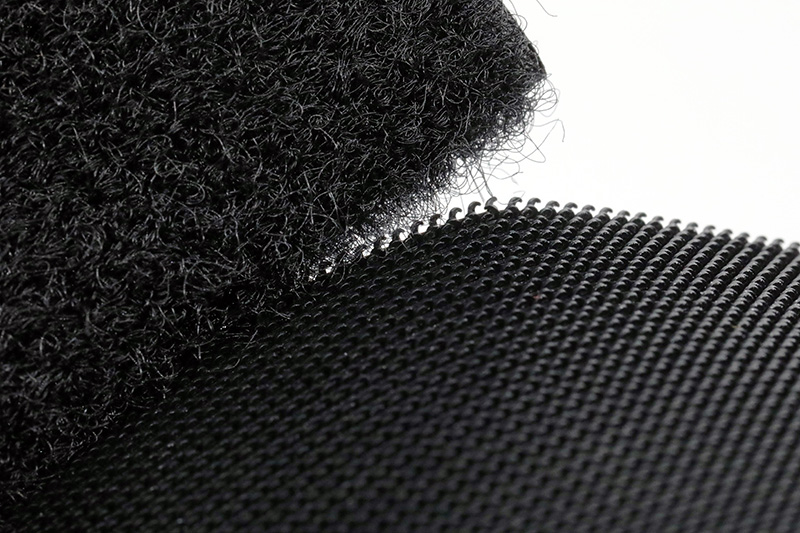
Where the joint carries higher load or is opened frequently, a heavy-duty moulded hook such as the VZ-35 extra-strong construction is usually the starting point, and where adhesive is ruled out altogether, a weldable nylon hook and loop removes the bond line from the design.
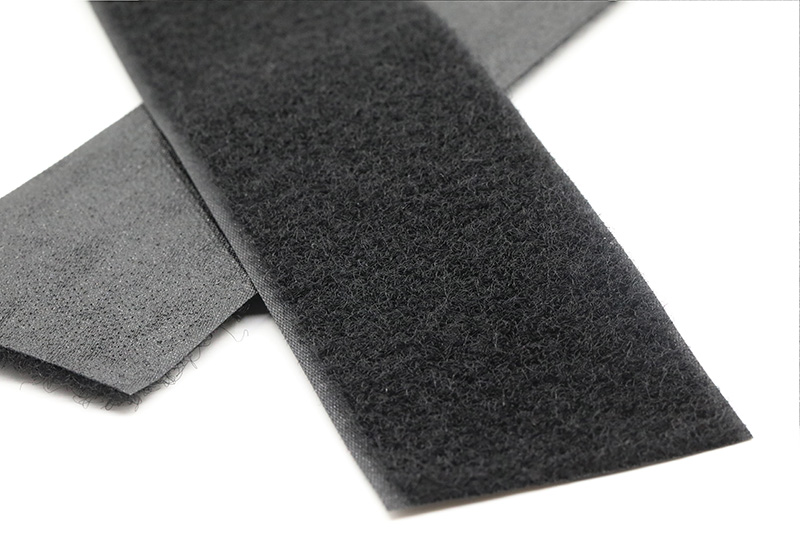
Testing matters more than catalogue numbers here. Our production bases in Zhejiang, Sichuan and Guangdong run incoming, in-process and final inspection with peel and shear testers, a fatigue rig and a high-low temperature chamber, so cycle life and heat ageing can be reported against the same sample you intend to buy.
Specification points and test methods
Write the test into the drawing before you write the price, because on low surface energy materials two fasteners that look identical in a photograph can perform very differently once the substrate is specified.
| Property | Common method | What it reveals |
|---|---|---|
| T-peel strength | ASTM D5170 | Force required to open the closure at a controlled angle |
| Dynamic shear | ASTM D5169 | Whether the closure slides under sustained load |
| Cycle endurance | In-house fatigue rig | Closure life before hook geometry degrades |
| Backing adhesion | ASTM D3330 (pressure-sensitive) | Whether the fastener's own backing grips the part |
| Dyne level | Dyne pen or contact angle | Whether the surface is ready to bond at all |
| Temperature ageing | Chamber cycling | Whether performance holds at service extremes |
Purchase risks worth pricing in
Most low surface energy failures are purchasing failures before they are technical ones, so budget for these points up front:
- Lot-to-lot surface variation. A resin change or a new mold release can move a surface from 34 to 30 dynes/cm without changing the part number.
- Treatment shelf life. Plasma and corona gains are temporary; stored parts may need re-treatment before bonding.
- Mixed-material assemblies. One bracket may combine PP, glass-filled nylon and a painted insert, each needing a different approach.
- Over-specified adhesion. Paying for a treated surface where a mechanical closure would do adds cost and a process step you have to control.
- Unverified substitution. A "same specification" fastener from another source can differ in hook density, loop pile height and backing, which shows up as short cycle life rather than immediate failure.
Frequently asked questions
Is low surface energy the same as low surface tension?
They are two sides of one measurement. Surface energy describes the solid, surface tension describes the liquid. Adhesion depends on the liquid's surface tension being clearly lower than the solid's surface energy.
Will a stronger adhesive solve the problem?
Rarely. A higher-strength adhesive that cannot wet the substrate still leaves voids at the interface. Raising the surface energy or changing to a mechanical closure solves more cases than upgrading the adhesive.
Does hook and loop work on polypropylene?
Yes, provided it is attached by a route that does not depend on wetting: ultrasonic welding, rivets, stitching, or a pressure-sensitive backing rated for low energy surfaces on a properly cleaned part.
How do I check surface energy on the shop floor?
A dyne pen or a dyne test ink is the simplest method: the ink wets and holds for two seconds at or above the surface's energy. Contact-angle measurement is more precise for qualification work.
Does surface treatment last indefinitely?
No. Plasma, corona and flame treatment decay over time and with handling. Treat the surface as a perishable process step, define a maximum dwell time before bonding, and verify it during first-article approval.



