


 English
 Français


A foam-backed fastener that keeps a nylon bag closed for five years can peel off a polypropylene tote bin in under a week. The hooks are undamaged; the backing gave up. Hook and loop backing is the rear face of the tape - the layer engineered to attach the fastener to a surface instead of to another fastener. It may be a pressure-sensitive adhesive under a release liner, a foam core, a heat-sealable film, or nothing more than a woven selvage you stitch through. That layer decides whether a closure survives two years of daily use or two weeks of summer heat, so it should be chosen before the hook profile.
What a Hook and Loop Backing Actually Is
A hook and loop tape is a layered assembly, and only one layer ever touches the opposite tape.
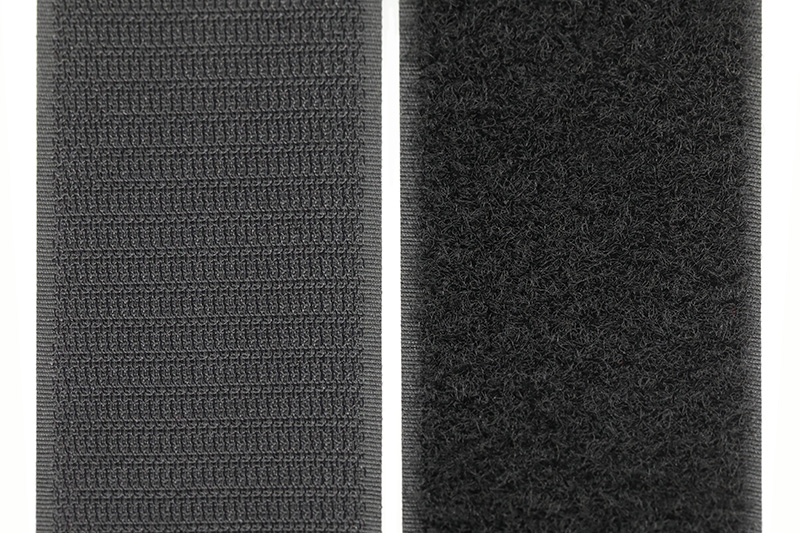
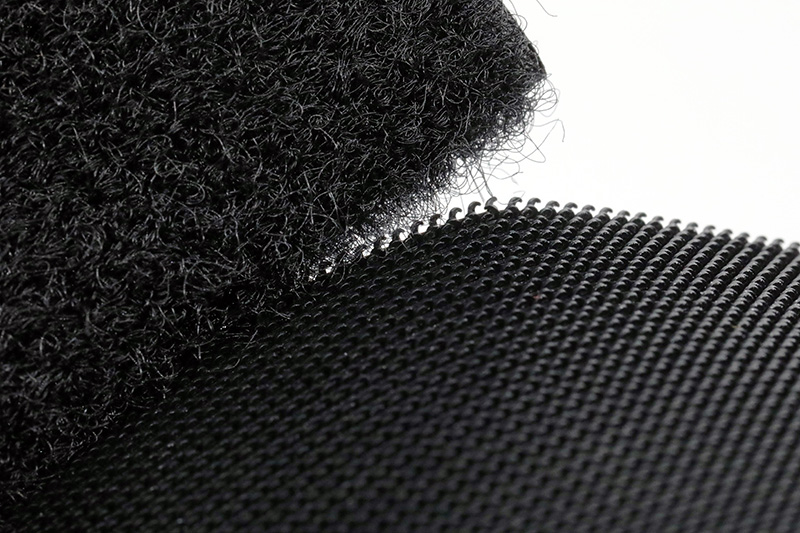
- Face: the hook or loop pile that forms the closure. It governs engagement feel, closure peel and cycle life.
- Carrier: the woven or knitted base that holds the pile and carries the tensile and stretch properties.
- Backing: the reverse side used to fix the tape to a product. Nearly every fastener failure reported from the field is a backing failure rather than a hook failure.
- Liner (optional): silicone-coated paper or film that protects an adhesive until the moment of assembly.
In buying conversations, "backing" is sometimes used to mean the loop side. The loop is functional; the backing is structural. The resistance you feel when you open a closure belongs to the hooks and loops. The resistance you need when an operator pulls a pad off a plastic panel belongs to the backing, and it can be several times higher or dramatically lower than the closure peel, depending on the adhesive or the stitching you specified.
Seven Backing Formats and Where Each One Belongs
Almost every hook and loop product on the market uses one of seven backings. They are not ranked; they solve different attachment problems.
| Backing format | How it attaches | Typical substrate | Common use | Main risk |
|---|---|---|---|---|
| Unbacked woven selvage | Stitched or stapled through the tape | Woven fabric, webbing, upholstery | Apparel closures, bag flaps, medical straps | Stitch holes weaken light fabric; stitches must avoid the pile |
| Standard sew-on | Stitched, with slight stiffening | Cotton, polyester, nylon textiles | Garment and cover closures | Bulkier than adhesive; unsuitable for plastics |
| Acrylic pressure-sensitive adhesive | Pressure plus 24-72 hours of dwell | ABS, PC, acrylic, painted metal, foam | Mounting pads, electronics, signage | Will not hold on PP or PE without a tailored acrylic |
| Rubber or hot-melt adhesive | Pressure, with very high initial tack | Cardboard, PVC foam, light panels | Packaging, indoor displays | Poor heat and UV ageing above roughly 60 °C |
| Foam-backed (PE or PU) | Adhesive foam core conforms to curvature | Curved mouldings, headliners, panels | Automotive trim, furniture | Foam creeps and cold-flows under sustained load |
| Film or PET tape-backed | Thin adhesive film, die-cuts cleanly | Rigid plastics, metals | Die-cut pads, cable management | Very little conformability on rough surfaces |
| Heat-seal or high-frequency weldable | Heat and pressure, or high-frequency welding | PP, PE, PU foam, coated textiles | Adhesive-free medical and automotive parts | Requires tooling and tight process control |
The pattern is consistent: the softer and more conformable the backing, the more it forgives a rough or curved surface, and the more it creeps under sustained load. Rigid film backings die-cut precisely and resist shear, but they will not lie flat on a compound curve.
Adhesive Chemistry Sets the Real Limits
When the backing carries adhesive, chemistry - not coat thickness - decides the temperature ceiling, ageing behaviour and cost.
- Rubber, solvent-based or hot melt: the fastest grab and the lowest price. Continuous service usually tops out near 60 °C, and UV exposure degrades it quickly.
- Acrylic: slower to build tack but holds 80-120 °C, resists UV and plasticiser migration. The default choice for outdoor, automotive and long-life assemblies.
- Hot-melt EVA and APAO: excellent for short-life packaging, weak under sustained shear.
- Silicone: 200 °C and above, with better tolerance of low-energy surfaces, at a much higher cost and with low initial tack.
Process discipline matters as much as chemistry. A pressure-sensitive adhesive needs pressure: a pad pressed by hand for two seconds may reach less than half of its potential bond, while a roller at moderate pressure followed by 24-72 hours of dwell at room temperature lets it approach the rest.
Which Numbers Predict Backing Performance
Three measurements separate a backing that survives from one that comes back as a complaint.
- Backing peel: 180-degree peel measured on the actual substrate, expressed in newtons per 25 mm. A quick hand pull on a clean panel is not a substitute.
- Shear holding power: a static load applied at elevated temperature, recorded as time to slip. This is where rubber and hot-melt adhesives fail first.
- Cycle retention: the closure peel remaining after thousands of open-close cycles. Quality nylon systems are commonly rated in the 5,000-20,000 cycle range, while thin low-profile loops and some molded hooks lose measurable performance within the first few hundred.
Test conditions belong in the specification: 72 hours of dwell, 23 °C and 50 percent relative humidity, 300 mm/min crosshead speed, and a substrate cleaned with isopropanol. As a practical rule, backing peel should exceed closure peel by a comfortable margin, so the tape opens at the closure instead of falling off the product.
Molded Hook or Woven Hook: a Pairing Decision
Molded hooks and woven hooks are not interchangeable, and the backing should be selected in the same decision.
- Woven textile hook: soft, thin and flexible, it pairs with standard loop pile and suits sew-on, foam and flexible adhesive backings. It is the right choice when the tape must follow fabric. Our textile hook and loop range covers all-nylon, all-polyester and blended constructions.
- Injection-molded PP or nylon hook: stiffer and denser, delivering higher peel per unit of width, which suits rigid film backings, die-cut pads and applications where the loop is thin or unnapped. The PP and nylon injection-molded hook design guide walks through material and process selection.
- Self-fastening nylon: the hook engages its own body, so no separate loop tape is needed and one backing layer disappears from the assembly.
 All Nylon Hook and Loop Fastener for Footwear and Cuff ClosureAll-nylon hook-and-loop fastener with neat hooks, dense loops, strong grip, and fatigue resistance, suited to footwear cuff closure and general fastening.View Product →
 VZ-35 Nylon Injection Extra Strong Hook and LoopSingle injection-molded PP/nylon hook for high snap-on force and toughness, suited to medical protective gear and shoe materials.View Product →
Where shear loads are high and space is limited, a stiff molded hook on a film or reinforced backing usually outperforms a woven hook of the same width, provided the loop side is matched to the hook density.
Specifying a Backing on the Purchase Order
A backing specification that survives tooling and production answers nine questions.
- Substrate material and surface energy - PP and PE need a targeted acrylic or a mechanical fixing.
- Service temperature, and how long the part stays at that temperature.
- Attachment process: roller pressure, heat, ultrasonic or high-frequency welding, stitching, or a combination.
- Required backing peel per 25 mm, measured on the real production substrate.
- Closure peel and the minimum backing-to-closure ratio you will accept.
- Width, length and die-cut tolerances, typically plus or minus 0.5 mm on slit width.
- Adhesive coat weight in grams per square metre, plus liner type and its release force.
- Colour, flame rating and any certification the finished product must carry.
- Storage and shelf life, commonly 12 months sealed at 20 °C and 50 percent humidity.
Backing Failures and How to Fix Them
Most complaints about hook and loop come back to six causes.
- Edge lift on PP or PE: a general-purpose acrylic cannot wet out low-energy plastic. Switch to a tailored acrylic or add a mechanical fixing.
- Creep inside a hot enclosure: the adhesive softens and slides under load. Move to acrylic, reduce the shear load, or add a rivet.
- Foam tear between backing and core: insufficient lamination pressure or an undercoated adhesive. Raising coat weight alone rarely fixes it.
- Hard liner release damaging die-cut parts: specify a lower release force and test liner removal at production speed.
- Molded hook paired with the wrong loop: a dense molded hook needs a matching pile height or a thin unnapped loop, otherwise peel drops sharply.
- Contamination at the bond line: dust, mould release and finger oils cut adhesion, so clean with isopropanol and bond within the same shift where possible.
Where Manufacturing Control Shows in the Backing
A backing is only as consistent as the process behind it. VEEZOT, built on the weaving base of Ningbo Hualei Weaving established in 2003, operates three production sites in Zhejiang, Sichuan and Guangdong. Zhejiang and Sichuan are the core manufacturing centres, with in-house factories and modern dyeing and finishing lines that control the chain from fibre weaving through to finishing, while Guangdong adds deep-processing technology and intelligent warehousing for faster customised response.
Full-chain control. Weaving, dyeing and finishing under one roof, so backing coat weight and web tension do not drift between suppliers.
Test equipment. Fatigue testers, softness testers, peel and shear testers, and high-low temperature chambers verify peel strength, durability and environmental tolerance.
Three-stage QC. Incoming material inspection, in-process monitoring and final product testing cover every batch against customer and industry standards.
Product breadth. Baby hook, PP and nylon injection-molded hooks, textile hook and loop, and a special category spanning flame-retardant, weldable, unnapped, tear-resistant and self-fastening constructions.
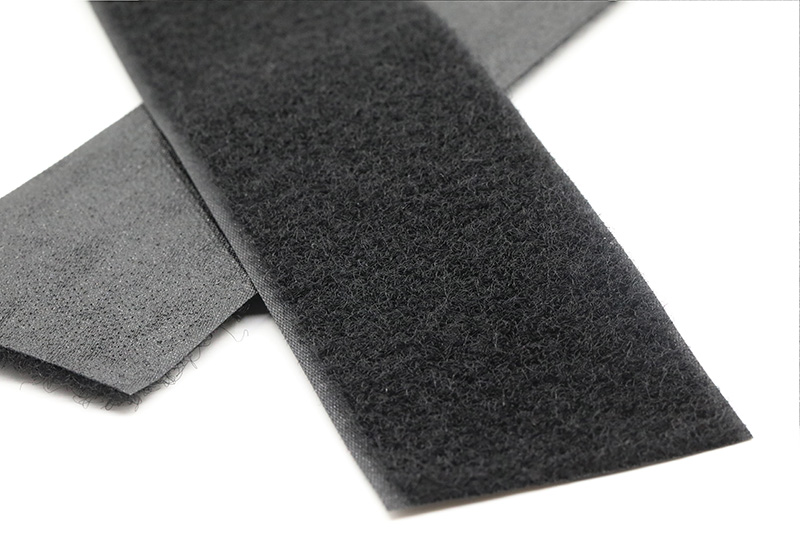
For assemblies that must avoid adhesive entirely, a heat-sealable or high-frequency weldable backing fixes the fastener to PP, PE or coated textile with no liner, no dwell time and no solvent exposure.
Frequently Asked Questions
Is hook and loop backing the same as the loop side?
No. The loop is the functional face that receives the hook. The backing is the rear attachment layer. A single tape can carry hook pile on one face and an adhesive backing on the other.
Can adhesive-backed hook and loop be used outdoors?
Yes, with acrylic adhesive and UV-stable nylon. Rubber adhesives and thin PP hooks age quickly in sunlight, so acrylic systems are the usual choice for outdoor products.
What backing should I choose for sewing?
An unbacked woven selvage or a standard sew-on backing. Adhesive only adds thickness, dulls needles and leaves residue in the seam.
Can hook and loop be bonded directly to polypropylene?
Sometimes. Standard acrylics usually will not hold on untreated PP, so a low-surface-energy acrylic, a surface treatment or a mechanical fixing is needed. Always test on production parts rather than laboratory coupons.
Does the backing affect cycle life?
Indirectly, yes. Cycle life is set by the hook and loop pile, but a backing that creeps or lifts lets the tapes misalign, which accelerates wear on both faces.
Hook and loop backing is a small line item with an outsized effect on returns, assembly time and warranty claims. Choose the attachment method first, confirm peel and shear on the real substrate under real conditions, and treat the backing as an engineered component rather than a commodity detail. That is usually the difference between a closure that quietly works for years and one that ends up in a complaint file.



