


 English
 Français

A prototype seat-back trim panel gets rejected because a 25 mm wide hook-and-loop closure along its edge burned faster than the limit set by FMVSS 302. Nobody on the program expected the fastener to be the problem; the foam and fabric underneath were. That is the trap. FMVSS 302 is a material-level rule, and the materials it covers include anything that ends up inside the occupant compartment, including the fasteners that hold the trim together.
The short version: FMVSS 302 caps the horizontal burn rate of vehicle interior materials at 102 mm (4 inches) per minute. Hook-and-loop fasteners used inside the cabin are expected to meet that limit, and the proof has to come from a test on a sample that matches what you actually buy — same fibers, same backing, same adhesive, same thickness.
What FMVSS 302 Actually Requires
FMVSS 302 is the US federal flammability standard for vehicle interior materials, and it has exactly one performance number: a burn rate no greater than 102 mm (4 inches) per minute.
Officially titled Federal Motor Vehicle Safety Standard No. 302, Flammability of Interior Materials, it applies to passenger cars, multipurpose passenger vehicles, trucks and buses. The standard lists the materials in scope — seat cushions, seat backs, seat belts, headlining, convertible tops, arm rests and interior trim — and then defines one horizontal test method and one pass line.
Three details are easy to miss. The test is horizontal, so a material that would fail a vertical test can still pass. The criterion is a rate rather than a burn length, so a thin strip that stops burning before the first timing mark passes no matter how far the char extends. And the specimen is conditioned and mounted in a specific way, which means the result only transfers to a product built the same way.
| Parameter | Typical requirement |
|---|---|
| Scope | Passenger cars, MPVs, trucks and buses; seat cushions and backs, seat belts, headlining, convertible tops, arm rests, interior trim |
| Specimen | 102 mm wide by 356 mm long (4 in × 14 in), thickness not more than 13 mm |
| Conditioning | Roughly 21 °C ± 2.8 °C and 50 % ± 5 % relative humidity for at least 24 hours |
| Ignition | Specified burner, flame applied to one end of the horizontally mounted specimen for 15 seconds |
| Timing marks | 38 mm and 292 mm from the ignited end |
| Calculation | Burn rate (mm/min) = 60 × 254 ÷ elapsed seconds between the two marks |
| Pass criterion | No more than 102 mm per minute |
| Early stop | A flame front that self-extinguishes before the 38 mm mark is treated as a pass |
Does Hook and Loop Have to Comply?
Yes. If a hook-and-loop fastener sits inside the occupant compartment, it is part of the interior material and is expected to hold a burn rate of 102 mm per minute or less.
There is a practical nuance. FMVSS 302 is written around materials, not around parts, and trim is usually a sandwich of fabric, foam, adhesive and fastener. If the fastener is laminated to a foam that burns, the assembly can fail even when the fastener alone passes. Component testing is the usual route out: the hook-and-loop is tested on its own, with a report that describes the sample precisely enough for a reviewer to confirm it matches production.
That last point is where most paperwork falls apart. A report stating "nylon hook and loop, flame retardant" is not enough. It should carry:
- The method actually used, such as ASTM D5132, ISO 3795 or FMVSS 302, with the revision stated
- Whether hook and loop were tested mated or separately, and one side only or both
- The construction: fiber type, backing, coating and adhesive present
- The width and thickness that were tested, not the nominal catalogue dimensions
- The measured burn rate in mm/min, not only a pass or fail statement
- The laboratory and the report date, so traceability can be checked later
Why Standard Nylon Hook and Loop Can Fail
Untreated nylon hook and loop can exceed the FMVSS 302 limit, especially when it is exposed, runs along the flame path, or is bonded to foam.
Nylon 6.6 is a combustible fiber. In a horizontal test it melts, curls and drips, and a dripping melt can keep feeding the flame front long enough to push the calculated rate above 102 mm/min. Whether a given fastener passes depends on a short list of variables, and two visually identical rolls can behave differently:
- Mass per area: heavier, denser constructions carry more fuel.
- Pile height and density: open, low-pile surfaces ignite and spread differently from dense ones.
- Backing and coating: polyurethane, acrylic and hot-melt backings add combustible material.
- Adhesive: a pressure-sensitive layer is another fuel source and is often the deciding one.
- Width and orientation: a narrow strip behaves differently from a full 102 mm specimen, so the tested width matters.
- Color and finish: dyes and FR finishes interact, and a shade change can shift the result.
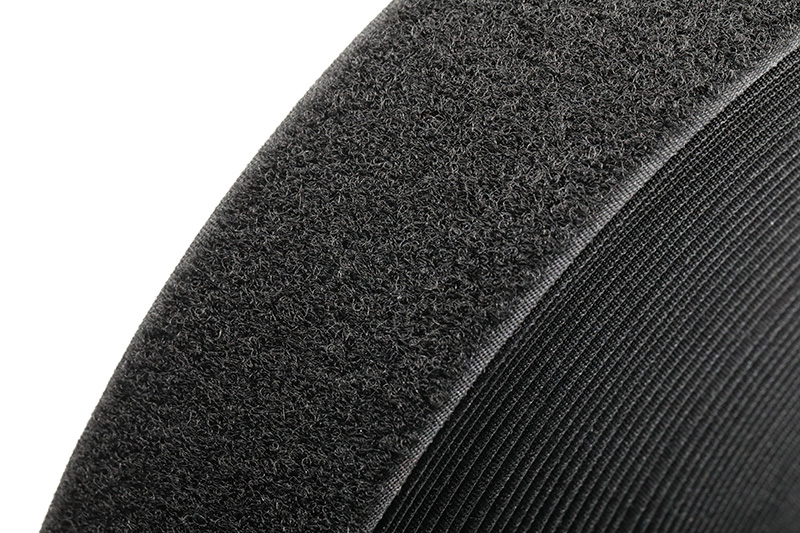
Where flame retardancy is a hard requirement, the practical answer is a fastener made from flame-retardant nylon rather than a standard grade.
How Flame-Retardant Grades Meet the Limit
Flame-retardant nylon hook and loop is the usual way to keep the peel strength, hand feel and cycle life of a fastener while pulling the burn rate below the FMVSS 302 pass line.
FR grades use modified nylon, often halogen-free phosphorus or nitrogen systems, that interrupts combustion in the solid phase and reduces melt dripping. In practice the change shows up in three places: higher unit cost, a slightly different stiffness, and possible effects on color fastness. Those trade-offs are manageable when they are designed in at the specification stage rather than discovered during a retest.
VEEZOT's flame-retardant and other special-category fasteners sit in this space, alongside weldable, tear-resistant, self-fastening and unnapped constructions built for the same industrial and transport applications.
Mechanical performance — peel, shear, fatigue and behaviour across temperature and humidity — is measured on instruments such as peel and shear testers, fatigue testers and high-low temperature chambers. Flammability results are a different matter: they should come from a laboratory running ASTM D5132 or ISO 3795, because the procedure depends on chamber geometry, burner calibration and timing that are hard to reproduce outside a dedicated setup.
What to Put in the Purchase Order
Write the standard, the sample configuration, the measured value and the change-control rule into the order. Vague claims of flame retardancy are the single biggest source of rejected lots.
- Cite the standard and the test method: "FMVSS 302, tested to ASTM D5132", or an ISO 3795 equivalent.
- State the sample configuration: mated or unmated, with or without adhesive, on the substrate actually used.
- Require the measured burn rate in mm/min, not just a compliance statement.
- Ask for the sample description: fiber, backing, coating, thickness and width.
- Name the laboratory and the report date.
- Tie any change to a retest: new FR masterbatch, new dye lot, new backing supplier or new adhesive all invalidate an earlier report.
- Keep the records for the life of the part plus the traceability period your customer requires.
Where the Fastener Sits Changes the Risk
The same hook-and-loop product can be low risk on a vertical pillar and high risk along a headliner edge, because exposure and geometry decide how much fuel the flame front meets.
| Application | Why it matters | What to specify |
|---|---|---|
| Headliner edge trim | Exposed, continuous path along the roof | FR grade, low mass per area, tested mated to the headliner substrate |
| Seat back closures | Tested as part of the seat assembly, foam underneath | FR grade with FR-compatible adhesive, sample description matching the seat build |
| Door and pillar trim | Large flat areas near wiring, often welded to PP | Weldable FR grade with no adhesive layer |
| Cable and harness routing | Small cross-section, long uninterrupted run | Self-extinguishing FR grade, with narrow-width test data |
| Child-seat pads and accessories | Outside FMVSS 302 scope but frequently requested by buyers | FR grade with a report, plus a clear statement of what was tested |
Attachment Method and Durability
How the fastener is attached changes the burn result almost as much as the fastener itself, and a sample that passes once is not proof of a part that lasts.
Sewing adds thread, which is more fuel. Adhesive adds a combustible layer and can be the difference between pass and fail. High-frequency welding bonds a weldable nylon fastener directly to a PP or ABS panel with no adhesive at all, keeping the total fuel mass lower and removing an assembly step.
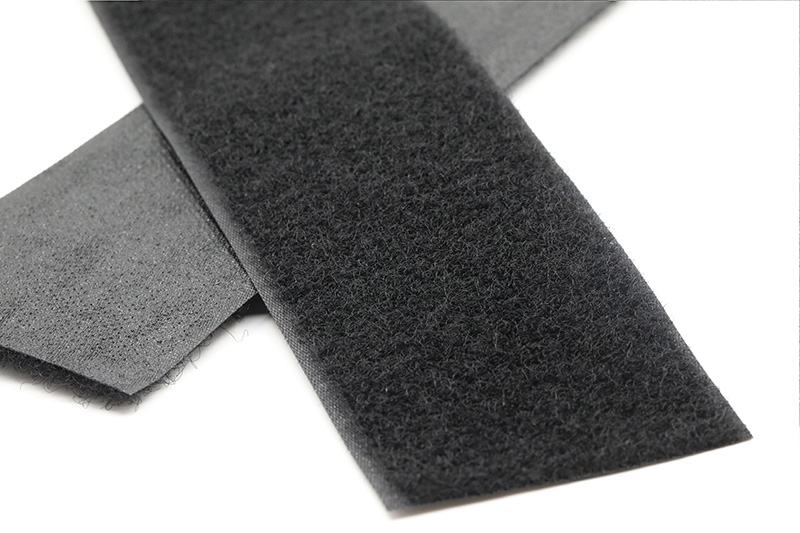
Durability matters for the same reason: a fastener that frays after a few thousand open-close cycles is no longer the sample that was tested. Tear-resistant constructions hold their edge, keep peel strength steadier over repeated cycles, and reduce the chance that a later production lot drifts away from the tested build. For a wider look at how these constructions behave in textile form, the comprehensive guide to textile fasteners covers fiber choice, weave and finishing in more detail.
FMVSS 302 Compared With Other Flammability Standards
FMVSS 302 is not the only flammability rule a fastener might face, and the differences are mostly about test orientation and the number that decides pass or fail.
| Standard | Sector | Method | Pass criteria |
|---|---|---|---|
| FMVSS 302 | US vehicle interiors | Horizontal, 102 × 356 mm | Burn rate ≤ 102 mm/min |
| ISO 3795 | International vehicle interiors | Horizontal, same geometry | Burn rate ≤ 102 mm/min |
| SAE J369 | US automotive practice | Horizontal | Burn rate ≤ 102 mm/min |
| GB 8410 | China vehicle interiors | Horizontal | Burn rate ≤ 100 mm/min |
| FAR 25.853 | Aviation interiors | Vertical, 12-second ignition | Burn length ≤ 203 mm, afterflame ≤ 15 s |
| UL 94 | Electronics and plastics | Vertical or horizontal small bars | V-0, V-1, V-2 or HB rating |
FAQ
What is the pass limit in FMVSS 302?
A burn rate of no more than 102 mm (4 inches) per minute, measured between the 38 mm and 292 mm timing marks on a horizontally mounted 102 mm × 356 mm specimen.
Do hook-and-loop fasteners need their own FMVSS 302 report?
If the fastener is inside the occupant compartment, expect to be asked for one. Many buyers accept a component report, provided the sample description — fiber, backing, adhesive, thickness and width — matches the production part.
Is FMVSS 302 the same as ISO 3795?
They are separate documents with the same test geometry and the same 102 mm/min limit, and ISO 3795 data is widely accepted outside the United States. The report should name the method actually used, because the two are not interchangeable on paper even when the result is the same.
How old can a burn test report be?
The regulation sets no expiry date. Buyers commonly ask for results issued within the last one to two years, and any change to fiber, FR additive, dye, backing or adhesive normally triggers a retest regardless of the report date.
Does passing mean the fastener will not burn?
No. Passing means the flame front travels no faster than 102 mm/min under the specified conditions. Self-extinguishing behaviour before the first timing mark counts as a pass, but a specimen can also pass while still burning slowly along its length.
Compliance in practice comes down to matching three things: the standard you cite, the sample that was tested, and the part you ship. When those three line up — same fiber, same backing, same adhesive, same thickness — a flame-retardant hook-and-loop fastener stops being a risk item on the trim list and becomes a documented component.
If a program is stuck on a burn-rate result, start by reading page two of the test report. The sample description usually explains the failure faster than any reformulation will.



