


 English
 Français

High temp Velcro is a hook and loop fastener whose closure strength survives continuous heat — the sort of heat that makes an ordinary nylon grade relax, deform and release. Most standard hook and loop is quoted at 90–120 °C continuous service, so anything above that band, whether it is an EV battery pack, an engine bay, an autoclave cycle or a firefighter garment, belongs to a different product family.
The short version: the fibre sets the ceiling, the attachment method usually sets the real-world limit, and only heat-aged test data tells you whether a supplier's claim means anything.
Four variables decide the outcome, and they are worth writing down before you contact anyone:
- Continuous temperature — what the joint lives at for hours, not seconds.
- Peak excursions — how hot, for how long, and how often.
- Attachment method — sewn, welded, adhesive-backed or mechanically fixed.
- Cycle life after ageing — how many open and close cycles the joint must still survive.
What Counts as High Temperature Hook and Loop
A high-temperature hook and loop grade is defined by its continuous service temperature, not by the melting point of the fibre inside it. Melting points are headline numbers; service temperature is an engineering number that has to hold after hours of exposure.
One terminology note first: Velcro is a trademark. The generic name is hook and loop, and that is how every manufacturer refers to it.
| Fibre | Typical continuous service | Melt / degradation | Where it fits |
|---|---|---|---|
| Nylon 6.6 (standard) | 90–120 °C | Melts around 255–265 °C | General closure, long cycle life, lowest cost |
| Polyester (PET) | 100–120 °C | Melts around 250–260 °C, softens earlier | Humid, wet and UV-exposed environments |
| Flame-retardant nylon | 120–150 °C | Modified nylon, self-extinguishing | Transport, protective gear, electronics |
| Aramid | 180–200 °C | Carbonises around 400 °C, does not melt | Aerospace blankets, turnout gear |
| PPS / PEEK | 200–250 °C | Roughly 280 °C / 343 °C | Niche high-heat industrial assemblies |
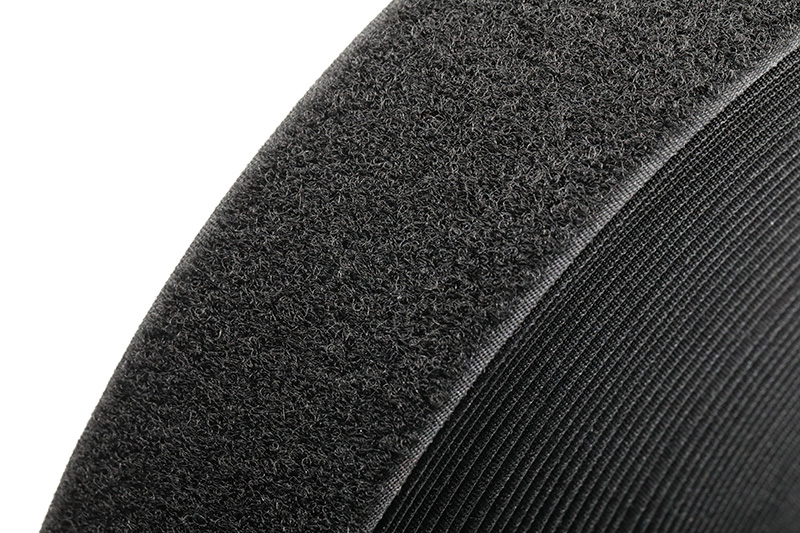
Why Ordinary Hook and Loop Fails in Heat
Heat destroys hook and loop through three separate mechanisms, and only one of them is melting. In real field failures the fibre rarely melts at all — the closure simply stops holding.
Creep in the hook filaments
Every hook is a thin monofilament working under load. Above the fibre's glass transition temperature it starts to straighten out under sustained peel or shear stress, and a hook that has crept open no longer engages the loop. Dried-out nylon 6.6 is particularly prone to this in hot air, which is why behaviour in a dry oven and behaviour in a humid 60 °C environment can differ so much.
Shrinkage and flattening of the loop pile
Loop yarns are finer than hook monofilaments, so they react to heat first. A loop that shrinks loses pile height, engagement depth drops, and peel strength falls with it. Woven, knitted and needle-punched constructions respond differently to the same temperature, so the loop side deserves as much scrutiny as the hook side when you compare samples; the comprehensive guide to textile fasteners walks through the main weave types.
Backing and adhesive failure
Adhesive-backed tape is the most common weak point in a hot assembly. A general-purpose acrylic pressure-sensitive adhesive softens around 120 °C, and rubber-based adhesives give up well below that. The fibre can be rated at 180 °C and the part still drops off the panel at 100 °C because of the adhesive behind it.
Matching Fibre to Your Temperature Band
For the 120–150 °C band a heat-stabilised or flame-retardant nylon is the practical answer; above 180 °C, aramid is realistically the only textile option that keeps working.
- Below 100 °C: standard nylon or polyester is fine, and blending fibres to control cost is reasonable. Our textile hook and loop range covers the all-nylon, all-polyester and blended options.
- 100–120 °C: polyester handles moisture and UV better than nylon, but its loop side can soften earlier under load, so it is not automatically the upgrade.
- 120–150 °C: flame-retardant and heat-stabilised nylons hold their shape longer and often carry the fire performance documentation that transport and electronics projects require.
- 180 °C and above: aramid carbonises rather than melts and is used in insulation blankets and turnout gear; expect shorter cycle life and a much higher price.
One practical distinction: blended tape is not a high-temperature product. If a blend includes polyester or cellulosic fibre, the limit of the weakest component becomes the limit of the whole tape, whatever the hook side is made from. An all-nylon construction is the safer baseline whenever heat is a factor.
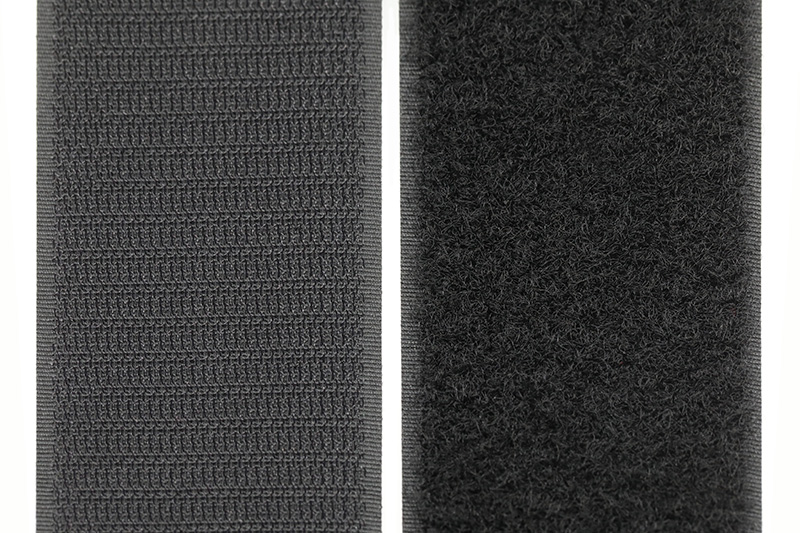
Backing and Attachment Usually Set the Real Limit
The fastener is rarely the weakest link in a hot assembly — the way it is attached is. A 150 °C-rated tape bonded with a 90 °C rubber adhesive is a 90 °C product.
- Sewn: the thread must be rated higher than the tape. Standard polyester thread softens well before aramid or FR nylon tape does, so specify aramid or PTFE-coated thread and check stitch density.
- Welded: high-frequency and ultrasonic welding remove the adhesive layer entirely, which is why they are common in automotive and medical assemblies. Welding suits polar thermoplastics such as nylon.
- Adhesive-backed: acrylic PSA to roughly 120 °C, silicone to 200–260 °C. Silicone costs more, has lower initial tack and needs pressure plus dwell time to develop full bond.
- Mechanically fixed: screws, clips and rivets have no thermal limit of their own, but they concentrate stress and can tear the tape edge.
For welded assemblies, a weldable nylon tape takes the adhesive out of the equation and lets the joint inherit the temperature rating of the textile itself.
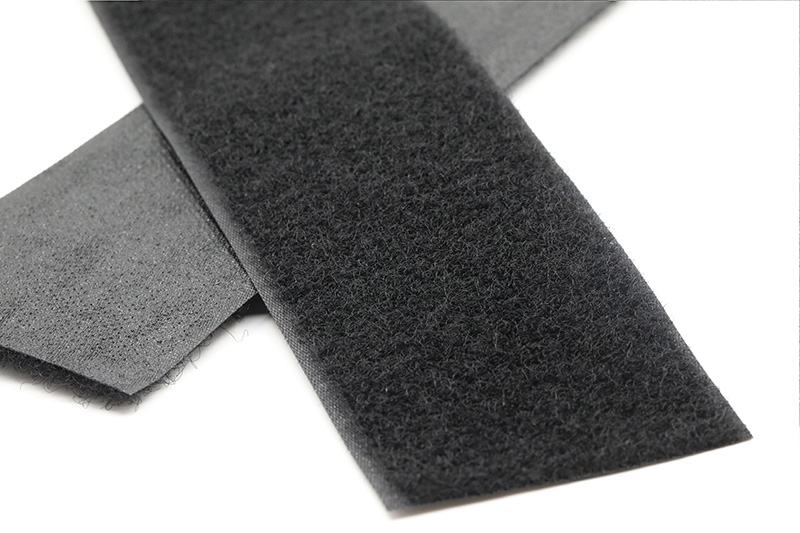
How to Qualify a High-Temperature Grade
Qualify on heat-aged peel and shear, never on a catalogue figure. Strength quoted at 23 °C says nothing about what happens after a week at 140 °C.
- Heat-age samples at the target service temperature for 72–168 hours.
- Cool them to 23 °C and condition before testing, because most specifications are written at room temperature.
- Measure peel (ASTM D5170) and shear (ASTM D5169) against an unaged baseline.
- Cycle the joint 1,000–5,000 times and re-measure; a heat-aged joint can pass a static test and still fail in service.
- Record dimensional change on both sides — 2–3 % shrinkage can separate a reliable closure from a loose one.
- Repeat the test on production lots, not only on the sample the sales team sent.
Ask for retention percentages rather than raw numbers, and ask what temperature and duration produced them.
Specification Mistakes That Show Up Later
Most high-temperature hook and loop problems trace back to a handful of specification errors.
- Treating the melting point as the service temperature.
- Specifying only the hook side and ignoring loop shrinkage.
- Rating the tape but not the adhesive, thread or weld.
- Testing new samples and assuming aged performance will match.
- Buying aramid where a 150 °C flame-retardant nylon would have done the job at lower cost.
Where High Temperature Hook and Loop Is Used
Heat-resistant hook and loop appears wherever a closure must be removable, adjustable and thermally stable.
- EV battery packs and busbar covers, where insulation blankets must not creep.
- Automotive under-hood cable routing, seat trim and headliner panels.
- Aerospace cabin insulation blankets and ducting wraps.
- Firefighter turnout gear and other protective clothing.
- Reusable sterilisation wraps cycled through 134 °C steam autoclaves.
- Industrial oven curtains, welding blankets and hot process equipment.
Frequently Asked Questions
What is the maximum temperature for high temp Velcro?
Standard nylon and polyester grades are typically rated to 90–120 °C continuous, heat-stabilised and flame-retardant nylons to about 120–150 °C, and aramid hook and loop to roughly 180–200 °C continuous with brief higher excursions. The practical ceiling is usually set by the adhesive or thread rather than the fibre.
Can I use standard hook and loop in an autoclave?
Not reliably. A 134 °C steam cycle sits above the creep threshold of standard nylon, and repeated cycles flatten the loop pile. Use a flame-retardant nylon or aramid construction with a matching thread or weld.
Does a higher temperature rating mean shorter cycle life?
Usually, yes. Aramid and similar high-performance fibres are stiffer and more brittle, so they tolerate fewer open and close cycles at room temperature than standard nylon, even though they retain far more strength at 180 °C.
How do I compare two suppliers fairly?
Ask for peel and shear values measured after the same heat-age profile, at the same temperature and duration, expressed as retention against an unaged baseline. If one supplier quotes fresh-sample figures and another quotes heat-aged ones, the higher number is usually the meaningless one.
Choosing a high-temperature hook and loop comes down to three decisions made in order: pick the fibre that matches your continuous temperature, pick an attachment method that survives the same heat, and verify both with heat-aged peel and shear data. Do that and the closure stops being the part of the design that fails first.
If you are working in the 120–150 °C band and want to compare constructions side by side, send over the temperature profile, the cycle count and the substrate, and we can shortlist the fibre and backing combination that fits before you commit to tooling.



